

A teacher once told my high school history class that $100 a month in a Roth IRA would make us millionaires. We finally checked the math.
In this guide
One of us got our first real money advice from a 12th-grade history teacher, Mrs. F. Her advice: open a Roth IRA at 18, put in $100 a month, and you’ll retire a millionaire. At 18, retirement felt a lifetime away, so it didn’t happen. The account finally got opened in our 30s, with kids. Years later, we wondered: was she right? The rule of 72 helped us find out.
What is the Rule of 72?
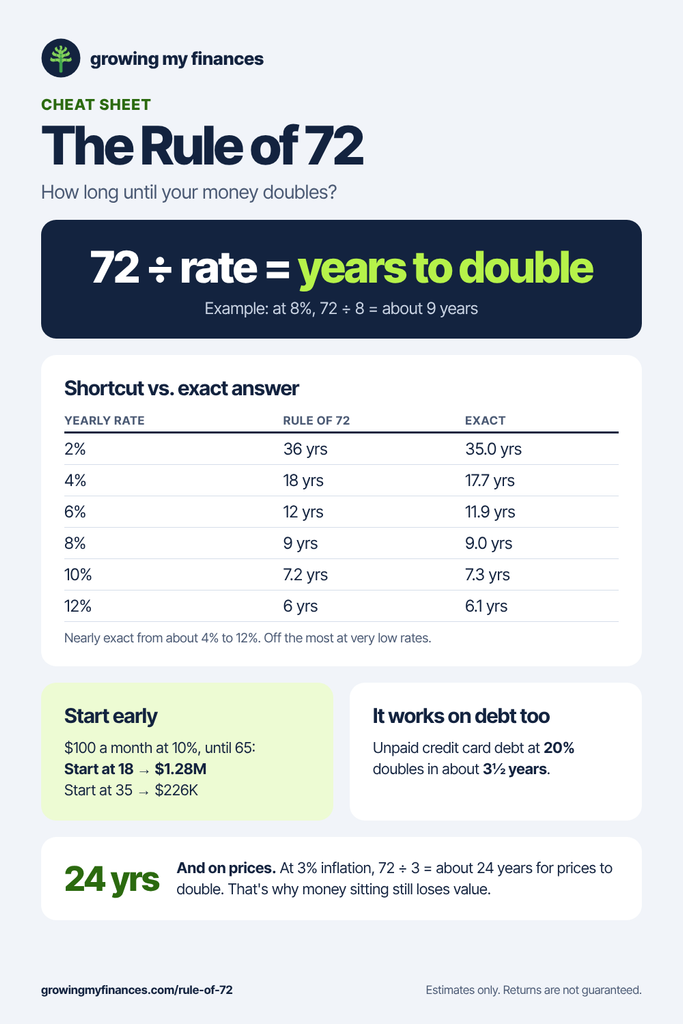
The rule of 72 is a quick shortcut for figuring out how long it takes money to double:
72 ÷ your yearly interest rate = years to double
| If your money grows at… | It doubles in about… |
|---|---|
| 4% a year | 18 years |
| 6% a year | 12 years |
| 8% a year | 9 years |
| 10% a year | 7.2 years |
| 12% a year | 6 years |
No calculator needed. That’s why people have used it for over 500 years.

We Tested the “$100 a Month” Advice
We ran our history teacher’s advice: $100 a month, every month, from age 18 to 65. That’s $56,400 put in over 47 years. The result depends on the average yearly return:
| Average yearly return | Balance at 65 |
|---|---|
| 5% | $226,000 |
| 7% | $439,000 |
| 10% | $1.28 million |
Our verdict: she was right, with fine print. The stock market has averaged about 10% a year over the past century (based on the S&P 500, according to NerdWallet), and at that rate, $100 a month really does reach a million.
The rule of 72 shows why. At 10%, money doubles about every 7 years. Over 47 years, your earliest dollars double about 6½ times.
The fine print:
- Returns go up and down. The 10% average includes some terrible years. Nothing is guaranteed.
- You can’t skip months. The math assumes $100 every single month for 47 years.
- Inflation shrinks it. Prices rise too. At 3% inflation, $1.28 million 47 years from now would buy about what $320,000 buys today. That’s still a great result from $100 a month.
The Real Cost of Waiting
Here’s what waiting until our 30s did. Same $100 a month, same 10% average, until 65:
| Start age | You put in | Balance at 65 |
|---|---|---|
| 18 | $56,400 | $1.28 million |
| 35 | $36,000 | $226,000 |
Waiting 17 years cut the result by more than $1 million, while only cutting what we put in by $20,400. To catch up, someone starting at 35 would need to save about $567 a month instead of $100, almost 6 times as much.
But starting late still works. $226,000 is a lot more than $0. The best time to start was at 18. The second-best time is today.
Try It With Your Numbers
Run your own numbers. Plug your age, monthly amount and rate into our free Compound Interest Calculator.
How Accurate is the Rule of 72?
We tested the shortcut against the exact math at every rate from 1% to 30%.
| Yearly rate | Rule of 72 says | Exact answer |
|---|---|---|
| 1% | 72 years | 69.7 years |
| 2% | 36 years | 35.0 years |
| 4% | 18 years | 17.7 years |
| 6% | 12 years | 11.9 years |
| 8% | 9 years | 9.0 years |
| 10% | 7.2 years | 7.3 years |
| 12% | 6 years | 6.1 years |
| 20% | 3.6 years | 3.8 years |
| 30% | 2.4 years | 2.6 years |
What we found: it’s almost exact between about 4% and 12%, the range most savings and investments fall in. It’s furthest off at very low rates, where it overestimates by up to about 2 years.
It Works Against You, Too
The rule of 72 doesn’t care whether the money is yours or someone else’s.
- Credit card debt: at 20% interest, an unpaid balance doubles in about 3½ years. See what happens when you [only pay the credit card minimum](link to Guide 1).
- Inflation: at 3% inflation, 72 ÷ 3 = about 24 years for prices to double. Money sitting in a jar quietly loses value.
Roth IRA Basics
A Roth IRA is a retirement account you fund with money you’ve already paid taxes on. Your money grows, and qualified withdrawals in retirement are tax-free.
- You need earned income (like a paycheck) to contribute, and you can’t put in more than you earned that year.
- The 2026 limit is $7,500 if you’re under 50 ($8,600 if you’re 50 or older).
- There are income limits. For single filers in 2026, contributions start shrinking at $153,000.
- You can usually open one at a bank, a credit union or an online brokerage, and many let you start with small automatic deposits, like $100 a month.
Keep Learning
We may earn a small commission if you buy through this link, at no extra cost to you.
If this sparked your curiosity, a beginner-friendly book like [book name] explains investing in plain English.
The Short Version
- 72 ÷ your interest rate = years for money to double.
- $100 a month from 18 to 65 at a 10% average grows to about $1.28 million, though that’s about $320,000 in today’s money.
- Waiting until 35 drops it to $226,000. Catching up takes almost 6× more each month.
- The rule works on debt too: 20% credit card debt doubles in about 3½ years.
FAQs
Who Came Up with the Rule of 72?
The earliest known written version comes from Italian mathematician Luca Pacioli, in his 1494 book Summa de arithmetica. The rule itself is probably even older.
What’s the difference between the rule of 72 and the rule of 70?
They’re both shortcuts. The rule of 70 is a little more accurate at low rates (around 2%), while 72 works best in the 6% to 10% range, and it divides evenly by more numbers, which makes mental math easier.
Does the Rule of 72 Work with Monthly Compounding?
Yes. Monthly compounding doubles your money slightly faster than the rule predicts, but the difference is small enough that the rule is still a good estimate.
How We Did the Math
We modeled $100 deposited at the end of each month, with returns compounded monthly at a steady yearly rate, from age 18 to 65 (47 years) and from 35 to 65 (30 years). Real returns go up and down, and nothing here is guaranteed. The inflation adjustment uses a steady 3% a year. The “exact” doubling times use the standard formula for yearly compounding. This is an educational example, not investment advice.
Sources
- NerdWallet: What Is the Average Stock Market Return?
- NerdWallet: 2025 and 2026 Roth IRA Income and Contribution Limits
- Wikipedia: Rule of 72 (history: Luca Pacioli, 1494)
This guide is for education only and isn’t financial, tax or legal advice.