
We paid the minimum on a $3,000 credit card for a year (on paper). It shrank by just $341. Here’s why, and how to get out faster.
In this guide
Credit cards are painless to swipe. There’s no loan application and no awkward conversation, and paying the minimum each month feels responsible. But if you’ve ever looked at your balance and thought, “Why isn’t this going down?”, you’re not imagining it. We wanted to see exactly how slow “slow” is, so we ran the numbers.
Why the Minimum Feels Like It Never Moves
Your credit card minimum payment is designed to keep your account in good standing, not to get you out of debt. Most of it goes to interest. And as your balance drops a little, your minimum drops too, so you end up paying less and less while the interest keeps coming. That’s why the debt shrinks, just very, very slowly.
How Is Your Credit Card Minimum Payment Calculated?
Every card company sets its own formula, and it’s listed in your card agreement. According to Experian, the most common methods are:
- A percentage of your balance, usually around 2% to 4%
- Interest and fees, plus about 1% of your balance
- A flat amount, like $25 or $35, when your balance is small
Many cards use whichever of these is higher.
What We Found: One Year of Minimum Payments
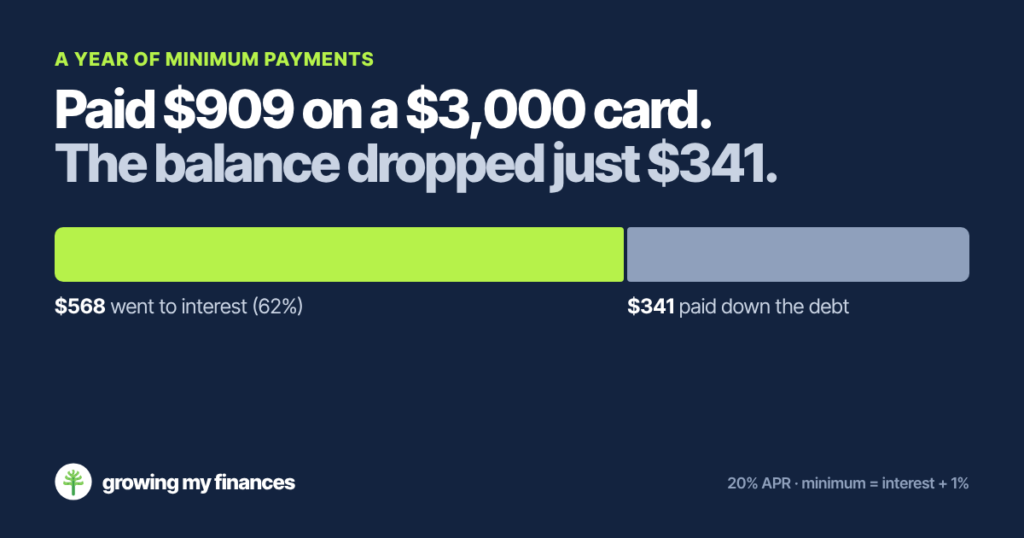
We took a $3,000 balance at 20% interest, close to today’s average credit card rate of about 19.7%, and paid only the minimum (interest plus 1% of the balance, at least $25), with no new charges.
After 12 months, we’d paid $909. The balance went down by only $341. About 62 cents of every dollar went to interest.
Here’s how it looks at different balances:
| Starting balance | Balance after 1 year | Paid that year | Went to interest | Time to pay it off | Total interest |
|---|---|---|---|---|---|
| $1,000 | $883 | $306 | $189 | 5½ years | $650 |
| $3,000 | $2,659 | $909 | $568 | 14.7 years | $3,983 |
| $10,000 | $8,864 | $3,030 | $1,894 | 24.6 years | $15,650 |
| $20,000 | $17,728 | $6,059 | $3,787 | 30.3 years | $32,317 |
At $3,000 and up, you’d pay more in interest than you originally borrowed.
Check your own statement: your credit card bill has a “minimum payment warning” box. It shows how long it would take to pay off your balance with minimum payments only, and how much you’d need to pay each month to be done in 3 years.
What Happens If You Pay a Little More?
This is the good news. Switching from the minimum to a fixed monthly amount changes everything. Same $3,000, same 20% rate:
| Monthly payment | Time to pay off | Total interest |
|---|---|---|
| Minimum (starts around $80) | 14.7 years | $3,983 |
| $100 | 3½ years | $1,193 |
| $150 | About 2 years | $680 |
| $200 | About 1½ years | $481 |
Paying $150 a month instead of the minimum saves about $3,300 and almost 13 years. The key is to keep paying the same amount even as your minimum drops.
How to Pay Off Credit Card Debt Fast
1. Stop adding to the balance.
Put the card away and use cash or debit while you pay it down.
2. List every debt.
Write down each card’s balance, interest rate and minimum payment.
3. Pick a plan: snowball vs. avalanche.
The snowball plan pays off your smallest balance first, for quick wins. The avalanche plan pays off your highest interest rate first, which saves the most money. Either way, pay the minimum on every card and put your extra money on one target.
4. Pick a fixed payment and stick to it.
Choose an amount you can pay every month, like $150, and don’t lower it when your minimum drops.
5. Roll each payment forward.
When one card is paid off, add its whole payment to the next one.
Try It with Your Numbers
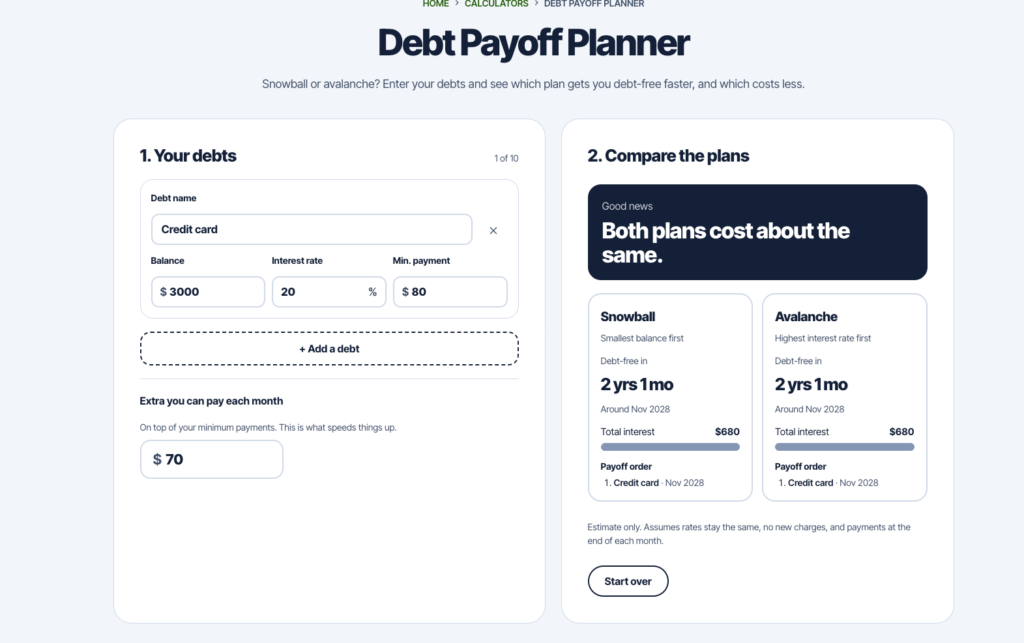
See your debt-free date. Enter your cards in the free Debt Payoff Planner to compare snowball and avalanche side by side.
Stay On Track
Paying off debt takes months, so make your progress easy to see.
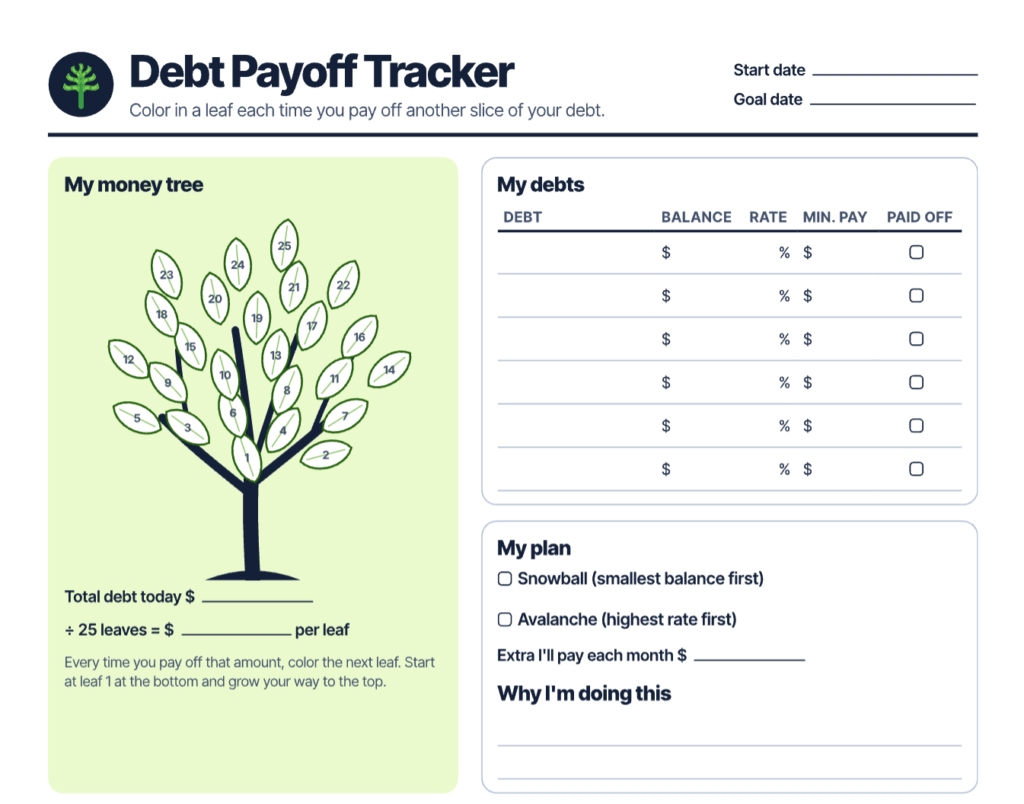
Want something free? Download our free printable Debt Payoff Tracker (PDF). Color in a leaf on your money tree every time you pay off another slice of your debt.
We may earn a small commission if you buy through this link, at no extra cost to you.
Prefer something reusable? A magnetic dry-erase bill tracker on the fridge works too.
The Short Version
- On a $3,000 balance, a year of minimum payments cut the debt by only $341. Most of the money went to interest.
- Minimum payments shrink as your balance shrinks, which is why payoff can take 15 years or more.
- Paying a fixed $150 a month instead saves about $3,300 and almost 13 years.
- Stop new charges, pick snowball or avalanche, and roll each payment forward.
FAQs
What happens if you only pay the minimum on a credit card?
Your account stays in good standing, but most of your payment goes to interest. A $3,000 balance at 20% would take about 15 years to pay off, with nearly $4,000 in interest.
Does paying only the minimum hurt your credit?
Paying on time helps, since payment history is the biggest part of your FICO score (35%). But carrying a high balance can hold your score down, because the amount you owe compared with your credit limits makes up about 30% of it.
How long does it take to pay off $5,000 in credit card debt?
At 20% interest with minimum payments only, about 19 years and $7,300 in interest. Paying $200 a month cuts that to about 2 years and 9 months, with around $1,500 in interest.
How We Did the Math
We built a month-by-month model using a 20% APR, a minimum payment of interest plus 1% of the balance (at least $25), and no new charges or fees. Interest was charged monthly on the remaining balance. Your card’s formula and rate may be different, so check your statement or card agreement for exact numbers. The fixed-payment results use the same method as our Debt Payoff Planner.
Sources
- Experian: How Is a Credit Card Minimum Payment Calculated?
- NerdWallet: How Credit Card Issuers Calculate Minimum Payments
- Consumer Financial Protection Bureau: What the minimum payment box on your bill means
- Bankrate: Current credit card interest rates (19.70% average APR, as of Oct 21, 2026)
- American Express: What Factors Impact Your Credit Score?
- Photo by DΛVΞ GΛRCIΛ: https://www.pexels.com/photo/credit-card-variety-pile-in-close-up-view-32641818/
This guide is for education only and isn’t financial, tax or legal advice.